In
his address following the ceremony of blessing the new St Wilfrid's
R.C. secondary school modern school at Litherland yesterday,
Dr William Godfrey (Archbishop of Liverpool) said that education
without a religious foundation was not worthy of the name.
An upbringing without this foundation he
said, could not produce the good citizen whose life was inspired
by the sense of service to God and his fellow men and whose
love embraced not only his own family but his nation and the
community of which he was a member.
Dr Godfrey said: “ During the few months
in which I have been Archbishop of this See with such a large
Catholic population I have been invited on several occasions
to lay the foundation stones of new schools or to bless and
open those already newly built. Anyone familiar with this city
and county, who knew conditions half a century ago, must be
impressed by the spacious buildings now erected for our children
and the facilities which modern development has placed at their
disposal.
“The citizens generally and the parents
particularly, when they see new schools such as the one we
are now admiring, will feel happy to know that their children
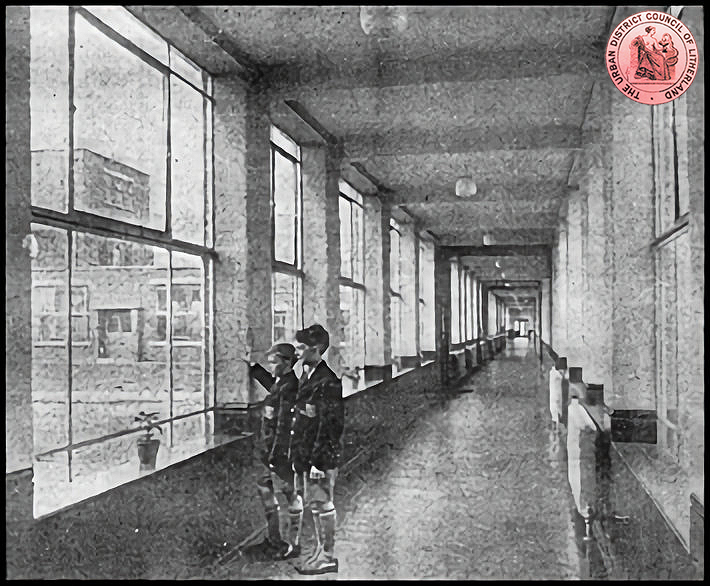
spend their school hours in so healthy an environment.
“ So
fine a building ”
“They will not feel any
misgiving that the material needs of the children have not
been the subject
of the careful consideration of the education authorities,
of architects and builders, and of the priests and people who
have all played their part in the provision of such fine a
building.
“I have found however, as I visited
the dioceses of Great Britain in recent years, that there is
a fear that the material development has not been matched with
an equally notable improvement in education. The general criticism,
which appears to be well founded, is that the minds of children
are now pulled in so many directions that they find it difficult
to master the ordinary subjects which we used to consider as
the basic essentials needed to equip a boy or girl for the
work of life.”
Spelling
errors
I think it is generally admitted that the
modern generation is rather complacent about errors in spelling.
One has even heard it remarked that all the best people spell
badly. Such things make one wonder whether educationalists
would not do better if they adopted the motto non multa sed
multum, which might be interrelated literally as not many things
well taught and well learned.
“We are aware that the teachers are
bound to a syllabus and so the critism just mentioned is no
reflection on teachers generally, since they are in the grip
of a system and are |
sometimes at the
mercy of theorists who possibly have never
handled a class of children but may simply be indulging their
own fads and fancies. Education offers a field for such experiments
and the children can suffer as a result.
“Some people might think that Catholics
lay undue stress on the function of religion in education.
They wonder why we cannot be satisfied with much less than
that which we demand. To this we answer that a religious instruction
which is vague and indefinite, cannot build the character of
a man, and the parents rightly demand that the environment
of the home should find its continuation in the school, and
that the teachers to whom they entrust their children should,
as their delegates — not delegates of the State—be
of such character as to continue the good work begun in the
home.
“This is surely an object worthy of
all striving and sacrifice and it is known to all of us that
the effort demanded of the Catholic body at present is enormous.
So that even with State aid we are hard pressed to play the
part allotted to us in the building of such schools as the
one happily blessed and formally opened to-day.
“I must conclude with congratulations
and thanks to all concerned in this great project—to
the local education authority, the chairman and board of governors
of the school, the architect (Mr Anthony Ellis), the contractors
(Messrs William Hall and Sons) and not least to the good people
of the parishes of this district who have had to raise the
sum of £56,000 towards the total cost of £226,000.
“We are glad to have as patron saint
of the school the illustrious northern prelate and sturdy Northumbrian,
Wilfred, Bishop of York, and we pray that by the intercession
of this holy servant of God, the work of the school may ever
prosper for God's glory and the good of souls.”
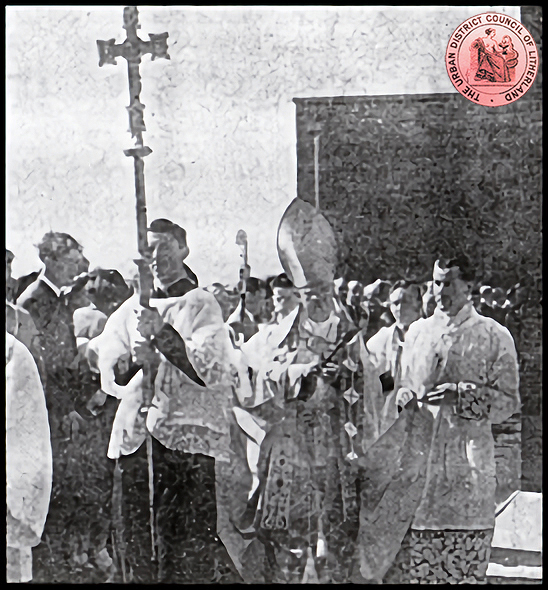
The ceremony of blessing the school began
outside the building and was completed within the main assembly
hall.
The guests included Councillor P. L. Kearney (chairman of Litherland
Urban Council), the Mayor of Bootle (Alderman Peter Mahon),
the Mayor of Crosby (Alderman J. Morris), and Sir Henry Hancock
(deputy chairman of Lancashire Education Committee). Mr H.
J. Brazendale (divisional education officer) and prominent
towns-people.
The Very Rev. Dean Wilcock (parish priest
of St Elizabeth's and chairman of the school's board of governors)
who presided, said that this was the first Catholic special
agreement school to be built in the area. Seventy-five per
cent. of the cost was being borne by the county who had done
all in their power to ease the financial burden which must
be undertaken by the parishes concerned.
A vote of thanks to the Archbishop was proposed
by Councillor Kearney and seconded by Alderman Mahon. |
.png)